What Salt Should I Use to Dry Age Beef
If you haven't tried it, you lot need to taste dry aged beef. Start saving now: it ain't cheap.
Y'all can occasionally buy aged beef from specialty butchers, or you can do it my favorite way: get three friends and head to a eatery that specializes in dry anile beef and do an expensive comparison tasting.
Or brand information technology yourself.
There are two types of anile beef, wet and dry out. Both aging methods are designed to allow enzymes to tenderize the meat, but the methods are very different. A few hours later a steer is slaughtered, its muscles get potent as rigor mortis sets in. This "green" beef is tough, dry, and not very tasty. It takes a few days for the muscles to relax and enzymes to kick in and begin to tenderize the meat. Enzymes are "nanocooks" in the words of nutrient scientist Harold McGee, and they practice what a professional cook does when cooking beef: they break downward the proteins, amino acids, and other compounds, creating new compounds including glutamates, the source of the savoriness known asumami, which is the main flavor we await for when eating steak. Equally the beefiness ages, more than interesting flavors emerge, and that is what the fuss is all nigh. But you lot can't historic period beef by only throwing it in the fridge and waiting for it to get tender. Oxygen and bacteria can mess information technology up.
Moisture aging
Before we dive deep into dry aging, here's a cursory explanation of wet aging, the technique used for well-nigh meat sold on the market place. At the slaughterhouse, meat is usually packed in plastic "cryovac" bags that take had nearly of the oxygen removed. Meat rarely stays in the bag for more than than 28 days. During that time, enzymes tenderize, but they accept minimal bear on on the taste of the meat. If y'all buy cryovacked meat, check the packing engagement and if you wish, you can store it in the fridge for upward to 28 days from the bagging appointment. Don't push button it beyond that, though, and don't try to pocketbook meat yourself. If there are bacteria on the meat or in the air; if at that place is oxygen in the pocketbook; or if there is a leak in the bag (and there well-nigh definitely can be any or all of these), things tin become south in a hurry. Simply but leaving the cryovacked meat in the fridge until 24-hour interval 28 gives enzymes more time to do their piece of work. Brisket cooks swear that wet aging up to 28 days makes a difference in the tenderness of this tough cut. If you effort it, ane discussion of caution: when you open a cryovac bag, the meat oftentimes smells odd. It is called the cryovac stink, and it normally dissipates within an hour.
Dry aging is controlled rotting
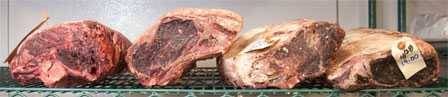
Some Egyptian royals were so addicted of dry aged beef they were cached with it (click here to read virtually some dry out aged beefiness ribs cached with the couple that loved information technology sooooo much). During dry out aging, the meat is stored in a germ-free room at 34 to 38°F and usually 70 to 80% humidity with brisk airflow for anywhere from 28 to 75 days. Dry aged beefiness is noticeably different tasting than fresh beef or wet aged beefiness. The longer it dry ages, the more complex it becomes. Some draw the gustation as earthy, nutty, gamey, leathery, mushroomy, and cheesy. Some say it can even develop notes of prosciutto. Some people are addicted to it. Some just plain don't like it. Earlier you decide to try dry aging at abode, go to a restaurant and try several "ages" of beef. In the picture below, we encounter bone-in rib primals in the dry out aging locker of David Burke'southward Primehouse in Chicago (closed in 2017). From left to right, they range from 7 days to twenty days, 30 days, and threescore days.
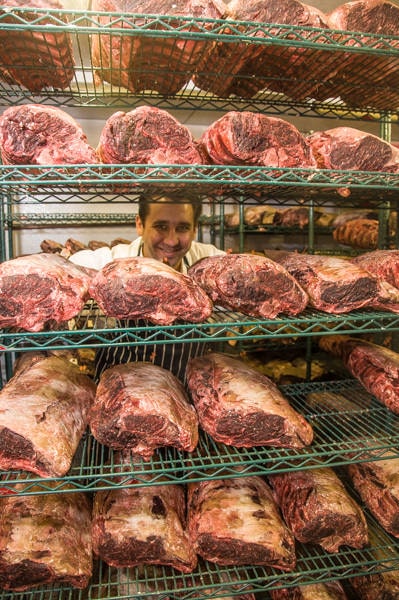
Aging works especially well on beef and bison, less well on other meats. It is non a good idea for pork, since pork fat goes rancid quickly. It is rare to find dry anile beefiness in grocery stores because most of them buy their meat in vacuum packed plastic bags. Some specialty butchers and high finish restaurants offer dry out aged beef. Only a few fancy steakhouses and upscale butchers take aging rooms. I accept had aged beef often only a while ago I had the opportunity to practise an aged steak tasting at David Burke'due south with the chef at the time, Chef Rick Gresh. They buy all their Black Angus from the same farm, and the farmer raises and feeds the cattle the aforementioned way (see a small portion of the aging beef below). I brought members of my team, and together we tasted ribeyes aged 28, 45, 55, and 75 days.
All of the aged steaks were wonderful, but all very different. After 45 days, the flavour had inverse and so that it no longer tasted like beefiness as we know information technology. It was as if the meat came from a different animal. Many of the changes in taste occur in the fat rather than the muscle. As for the texture, beyond 45 days, I was unable to notice much difference in tenderness. My favorite was the 28 24-hour interval steak because it had not yet gotten funky, simply the flavors were concentrated and the meat was oh so tender. Others preferred the older meats, proving once again that taste is a thing of gustatory modality.
Will yous similar the taste of dry aged beefiness? The question is similar to: Which do you prefer, beefiness or lamb? Mayo or Miracle Whip? Polish or chunky? It'southward a personal preference. Merely in that location's one fashion to discover out. Find a steakhouse that ages beef and sense of taste information technology.
Dry aging is sometimes chosen controlled rotting because enzymes, molds, bacteria, and oxygen get to work on the meat. The exterior of the musculus gets night purple and a small amount of moisture evaporates, shrinking the meat about 5% (as Kenji Lopez-Alt explains, it is not the dramatic 20% shrinkage yous may accept heard about).
Every bit water evaporates, flavors concentrate, then the meat tastes more meaty. While h2o evaporates, fat does non, so the ratio of musculus to marbling changes. The meat becomes fattier overall. The higher the fat ratio, the richer and juicier the meat feels in the mouth, proving once once more that the juiciness sensation is acquired past much more the water content of the meat. Fat plays a meaning role in juiciness.
Only earlier cooking dry out anile beef, the outside chaff is trimmed off, and the meat is sliced into steaks, and so another 10 to 15% of the weight is lost. Tin you see at present why aged steaks are then expensive? The selling price is an additional $1 per crumbling twenty-four hours on superlative of the normal toll. And that's why it pays to age beef yourself at home. You lot pay merely for the steak, not the aging (despite some loss in the total weight).
Don't bother aging single steaks
Alton Brown of Good Eats on the FoodNetwork likes the idea of aging single steaks and instructs us to "Wrap the steak in a single layer of paper towels and put on a cooling rack gear up inside a half sheet pan. Refrigerate 24 hours. Discard the paper towels, rewrap and return to the refrigerator, on the rack, for 3 days. Change the newspaper towels once again if they get damp and stick to the steak. An hour before cooking, remove the steak from the refrigerator and remove the paper towels. Thirty minutes earlier cooking, sprinkle the steak on both sides with the kosher table salt." I accept tried it and, although I usually concord with AB, it was a heckuva lotta piece of work for very picayune improvement, and I'm not certain there was any improvement.
How to historic period beefiness at home the old fashioned way
Ready to historic period some beef? Start, select high quality meat, at least USDA choice or USDA prime, preferably tightly wrapped in a vacuum pack cryovac bag. Fresh meat is best, but if you have frozen, Chef Gresh says it is of import that you defrost the meat slowly in the fridge, not under running water, to help preserve its integrity. Side by side, become the right cuts. You want to kickoff with a prime rib roast that weighs 20 pounds. Or a strip loin. Or a sirloin. No tenderloin. It is already very tender, it is low fat, and it can get mushy with age. These are expensive meats, then don't screw around or take shortcuts with the aging process. That's a lotta meat. But what y'all don't use right away after crumbling, y'all tin can freeze.
In that location are 5 variables that you must control: Quality of meat, temperature, airflow, days of aging, and to a lesser extent, humidity. Some people use their kitchen refrigerator for crumbling beef. I don't recommend it. The door opens and closes, moist and warm air and microbes enter, and there are lingering smells in there that the meat will happily absorb. If there is any mold on the shelf from the time you spilled the milk or craven juices or mold in the onion drawer, you likely will fail (remember: that meat is expensive!). Information technology is best if you take a 2d fridge used just for aging meat. If you want to store some beer in at that place, OK, but brand sure the bottles are clean. Make certain the fridge is clean. Turn it off, wipe it down with soapy h2o, rinse, and rinse once more than with a bleach solution made with one tablespoon of five% unscented liquid chlorine bleach per gallon of clean h2o. Then air it out to get rid of the chlorine odor. Some folks buy a small dorm fridge or a keg fridge and dedicate it to this purpose.
The refrigerator should be kept at 34 to 38°F. Whatsoever lower than 32°F and the enzymes will keep strike. Above 40°F spoilage microbes tin grow. Even if y'all aren't aging meat, your fridge should be set to 38°F max. It significantly reduces spoilage, even in comparison with 40°F. And, of course, y'all demand a reliable thermometer. A dial thermometer is not reliable. Commonly I recommend digital thermometers, simply a liquid bulb thermometer is accurate enough for refrigerator temps.
Many experts believe humidity is critical with the ideal beingness lxxx to 85%. Recent enquiry says don't sweat information technology. According to a 2008 technical paper on Aging Beefiness by Professor Jeff Due west. Savell, PhD, of Texas A&M, "There are no published studies that take compared the effects of different relative humidity levels on dry out-anile beefiness, and it appears the studies in this area have used a relative humidity of approximately lxxx% with a considerable range around that number."
Wash the outside of your sealed cryovac purse with soap and h2o before opening information technology. Then open information technology, drain off the liquid, and wearing gloves so you lot don't contaminate the meat, rinse off the slime and then pat the meat very dry. Go out the fatty and bones in place: they will reduce evaporation during the crumbling process. After aging, you will desire to remove them. But for now, counterbalance the meat so you can summate the weight loss.
Take a large pan wider and longer than the meat, and make full it with almost 1/2″ of salt. It doesn't matter what kind of table salt. Just common salt is corrosive, so you do not want to utilize an aluminum pan. Stainless steel, glass, or porcelain pans are OK. The salt will absorb drips, moisture, and odors.
Put the meat on a wire rack, preferably stainless steel or coated with nickel or plastic, and place the racked meat on top of the pan in a higher place the salt. Don't use a roasting rack, which holds the meat below the walls of the pan. You desire aplenty airflow all around the meat. If you don't have a suitable rack, you tin put the meat on the (cleaned!) top rack of the fridge and put the table salt pan on the rack beneath.
Ample airflow helps to move moisture away from the meat's surface. Professor Greg Blonder, the AmazingRibs.com science advisor, uses a fan from a dead figurer and runs the cord between the door gasket and the door jamb. I use this 5″ battery powered fan with an AC adapter. I thread the cord through the fridge door gasket on the hinge side and it does a fine job of keeping the air flowing and moving moisture off the meat. To help stabilize the fridge temp, put a few gallon jugs of h2o in fridge to chill. The common cold jugs of h2o will help the fridge recover its temp after information technology has been opened and closed.
Some recipes phone call for wrapping the meat in cheesecloth, kitchen towels, or paper towels, and replacing them every twenty-four hour period. The idea is that the wrapping pulls wet to the surface and helps wick it abroad. Don't bother with these shrouds. You lot want the meat fully exposed to dry air, non in contact with wet cloth.
The next step is the beauty of this technique: do nix. Just let the meat age. And allow it go for at least three weeks. Gustation tests testify minimal flavor changes in meat aged less than ii weeks, only most people can taste subtle changes after 3 weeks. At nearly 28 days, flavor changes become more obvious. You tin can go longer, and you might desire to push the envelope to run across what age is your fave.
When you are ready to eat, there are 2 means to go.
1) You can trim about one/iv" of the black chaff and the bones off the entire slab. You lot'll need a sharp potent bladed knife for this because the meat has dehydrated and will feel hard. An electric knife works fine. Throw out the trim, and cut what's left into steaks and roasts. Wrap everything in plastic. You can refrigerate the pieces you plan to eat inside a day or three, and freeze the rest.
ii) You tin can cut off just the corporeality yous want to swallow, trim that corporeality, and leave the rest of the slab to continue crumbling.
Now tuck in for a treat!
Drybag aging
In recent years, a clever new product has come up on the market, the UMAi Dry out system. This visitor makes transparent numberless in which you place meat and, with a vacuum sealer, draw out the air and seal the bag. The UMAi textile is not a conventional plastic, every bit you lot can see here in a photograph by Jaden Hair of SteamyKitchen.com. Moisture volition not drip out, but information technology will evaporate out. Inquiry by a team from Kansas State University and Sweden published in the journal Meat Science has shown that the bag's permeability does not create an anaerobic surroundings, so unsafe botulism bacteria cannot grow, and other microbes are too large to enter the bag. For this reason, the manufacturer claims, "If yous want to dry historic period cleanly and safely in any refrigerator or cooler, excellent air menstruum and the awarding of UMAi fabric is the combination about likely to give you excellent results." As you tin can see, the procedure differs a flake from the quondam fashioned organization where air and leaner tin can contact the meat. Alas, not every vacuum sealer volition work with the numberless. The visitor sells its own sealers, and they are expensive. And so is the bag material. I take not yet tested this product, but it's worth exploring if you program to age beef regularly at home.
The SteakLocker
It's easiest to buy a small-scale dorm-style fridge defended to the task of aging meat. Or you lot can invest $one,449 in the Steak Locker. It is temperature and humidity controlled with a carbon filter, a UV low-cal to kill bacteria, and a glass door and then you can watch your meat age. It even talks to your smartphone with readings of temp, humidity, and elapsed fourth dimension. I take not tested information technology all the same.
The SteakAger
Another aging environment, the SteakAger, has been in development a long fourth dimension through crowdfunding. I strongly recommend you look until we have had a chance to test information technology. The basic model is a roughly ane foot square plastic box that fits inside your refrigerator. On top, it displays temperature, humidity, and a mean solar day counter. There is a clear plastic front, a fan, and a UV light to kill bacteria. It is pocket-sized with a capacity of only 22 pounds, but that could be the right size for fans of dry aging beef at home. They also sell a larger and more expensive refrigerated version that has a xl pound chapters.
Fake dry aging
In his volume Modernist Cuisine at Abode, food scientist Nathan Myhrvold simulates the taste of dry-aged beefiness by marinating steaks in fish sauce for three days and then air drying them for three more days. Hither's the basic recipe.
2 boneless ribeye steaks about i″ thick
1 1/ii tablespoons Asian fish sauce
Morton's Coarse Kosher Common salt
Ground blackness pepper
Method
1) Place the steaks in a large attachment bag in a single layer. Add the fish sauce and clasp out as much air every bit possible and zip it upwardly. Scroll information technology around until the meat is coated and make certain the steaks are not overlapping. Identify on a plate in the fridge for three days. Once a day, squish things effectually to make sure everybody is well coated and plow them over.
two) Remove the meat and tightly wrap with a double layer of cheese material. Identify a wire rack over a plate and identify the steaks on the rack and return to the refrigerator, uncovered, for three more days.
3) Remove the plate and rack, unwrap the steaks, salt and pepper them, and identify dorsum on the rack at room temp for thirty minutes.
4) Preheat a hot grill and melt until 125°F in the center and serve immediately.
Koji-rubbed beef
Koji is a rice that has been fermented withAspergillus oryzae, a fungus used in making miso, tamari, and soy sauce. Y'all can buy it online. Take some koji and powder it in a blender and rub it all over a steak and sit it on a wire rack without a cover in the fridge for 3 days, no more. Overnight the meat starts to look similar information technology has been covered in snow. Rinse off all the snowfall in common cold water and pat dry out with paper towels. And so dry out brine and grill. the results are rich and nutty, similar to aged beef.
Source: https://amazingribs.com/technique-and-science-cooking-science-aging-beef-at-home/
0 Response to "What Salt Should I Use to Dry Age Beef"
Postar um comentário