Probability That 13 Students Will Take Up Art Poisson Dist
Poisson Distribution — Intuition, Examples, and Derivation
When to employ a Poisson Distribution
Before setting the parameter λ and plugging it into the formula, let's pause a second and ask a question.
Why did Poisson have to invent the Poisson Distribution?
Why does this distribution be (= why did he invent this)?
When should Poisson be used for modeling?
ane. Why did Poisson invent Poisson Distribution?
To predict the # of events occurring in the future!
More formally, to predict the probability of a given number of events occurring in a fixed interval of time.
If yous've e'er sold something, this "event" can be defined, for example, equally a client purchasing something from you (the moment of truth, not just browsing). It can be how many visitors y'all get on your website a day, how many clicks your ads get for the next month, how many telephone calls y'all become during your shift, or even how many people will dice from a fatal disease side by side yr, etc.
Beneath is an example of how I'd use Poisson in real life.
Every week, on average, 17 people clap for my blog post. I'd like to predict the # of ppl who would clap side by side calendar week considering I get paid weekly by those numbers. What is the probability that exactly 20 people (or x, 30, fifty, etc.) will handclapping for the web log post next week?
2. For now, let's assume we don't know anything about the Poisson Distribution. Then how practise we solve this trouble?
One fashion to solve this would be to get-go with the number of reads. Each person who reads the blog has some probability that they volition really similar it and clap.
This is a classic job for the binomial distribution, since we are calculating the probability of the number of successful events (claps).
A binomial random variable is the number of successes x in n repeated trials. And we assume the probability of success p is constant over each trial.
Nevertheless, hither we are given only one piece of information — 17 ppl/calendar week, which is a "rate" (the boilerplate # of successes per week, or the expected value of x). We don't know anything near the clapping probability p, nor the number of blog visitors northward.
Therefore, we demand a little more information to tackle this problem. What more do we demand to frame this probability equally a binomial problem? We need two things: the probability of success (claps) p & the number of trials (visitors) n.
Let's get them from the by data.

These are stats for ane twelvemonth. A total of 59k people read my blog. Out of 59k people, 888 of them clapped.
Therefore, the # of people who read my blog per calendar week (north) is 59k/52 = 1134. The # of people who clapped per calendar week (ten) is 888/52 =17.
# of people who read per week (north) = 59k/52 = 1134 # of people who clap per week (x) = 888/52 = 17 Success probability (p) : 888/59k = 0.015 = 1.5%
Using the Binomial PMF, what is the probability that I'll get exactly 20 successes (twenty people who clap) next week?
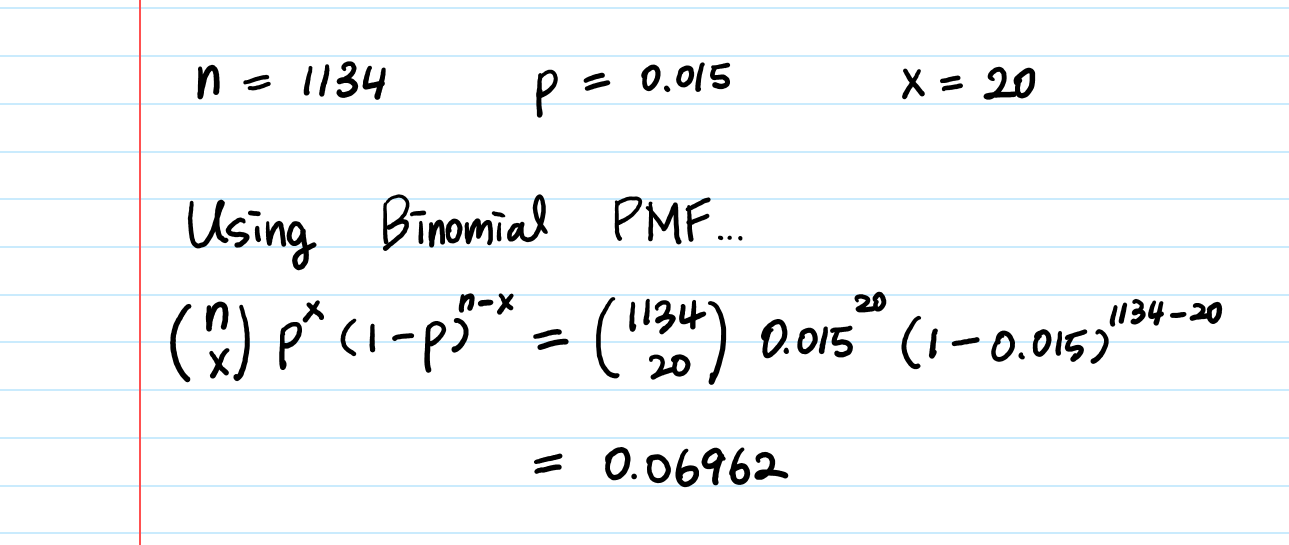
            <Binomial Probability for different              x'south>            ╔══════╦════════════════╗
║              x              ║ Binomial P(X=10)║
╠══════╬════════════════╣
║  ten  ║    0.02250     ║
║              17              ║              0.09701              ║  🡒 The average rate has the highest P!
║  twenty  ║    0.06962     ║  🡒 Nice. twenty is also quite Probable!
║  30  ║    0.00121     ║
║  forty  ║  < 0.000001    ║  🡒 Well, I guess I won't become 40 claps..
╚══════╩════════════════╝
We just solved the problem with a binomial distribution.
Then, what is Poisson for? What are the things that simply Poisson can practise, simply Binomial can't?
iii. The shortcomings of the Binomial Distribution
a) A binomial random variable is "BI-nary" — 0 or 1.
In the to a higher place example, we have 17 ppl/wk who clapped. This means 17/7 = 2.4 people clapped per day, and 17/(7*24) = 0.1 people clapping per hr.
If we model the success probability by hour (0.1 people/hr) using the binomial random variable, this means well-nigh of the hours get aught claps but some hours will go exactly 1 clap. Nevertheless, it is also very possible that certain hours volition get more than 1 clap (2, three, v claps, etc.)
The problem with binomial is that it CANNOT contain more than ane event in the unit of time (in this case, 1 hr is the unit time). The unit of time tin only have 0 or one outcome.
So, how about dividing i hour into 60 minutes, and make unit fourth dimension smaller, for example, a minute? Then ane hour can contain multiple events. (Still, one minute volition contain exactly ane or nothing events.)
Is our problem solved at present?
Kind of. Only what if, during that one minute, we get multiple claps? (i.due east. someone shared your weblog mail on Twitter and the traffic spiked at that minute.) Then what? Nosotros can divide a minute into seconds. Then our time unit of measurement becomes a second and over again a minute can contain multiple events. But this binary container problem will always exist for e'er-smaller time units.
The idea is, we can make the Binomial random variable handle multiple events by dividing a unit fourth dimension into smaller units. By using smaller divisions, nosotros can brand the original unit time contain more than than one outcome.
Mathematically, this means north → ∞.
Since we assume the rate is fixed, we must accept p → 0. Because otherwise, n*p, which is the number of events, will accident upward.
Using the limit, the unit times are now infinitesimal. We no longer have to worry almost more than than one event occurring within the aforementioned unit of measurement time. And this is how we derive Poisson distribution.
b) In the Binomial distribution, the # of trials (due north) should be known beforehand.
If you lot use Binomial, you cannot calculate the success probability only with the charge per unit (i.due east. 17 ppl/calendar week). You need "more info" (n & p) in order to utilize the binomial PMF.
The Poisson Distribution, on the other hand, doesn't require you lot to know n or p. We are assuming northward is infinitely large and p is infinitesimal. The just parameter of the Poisson distribution is the rate λ (the expected value of x). In real life, only knowing the charge per unit (i.eastward., during 2pm~4pm, I received iii telephone calls) is much more than common than knowing both n & p.
4. Let'south derive the Poisson formula mathematically from the Binomial PMF.
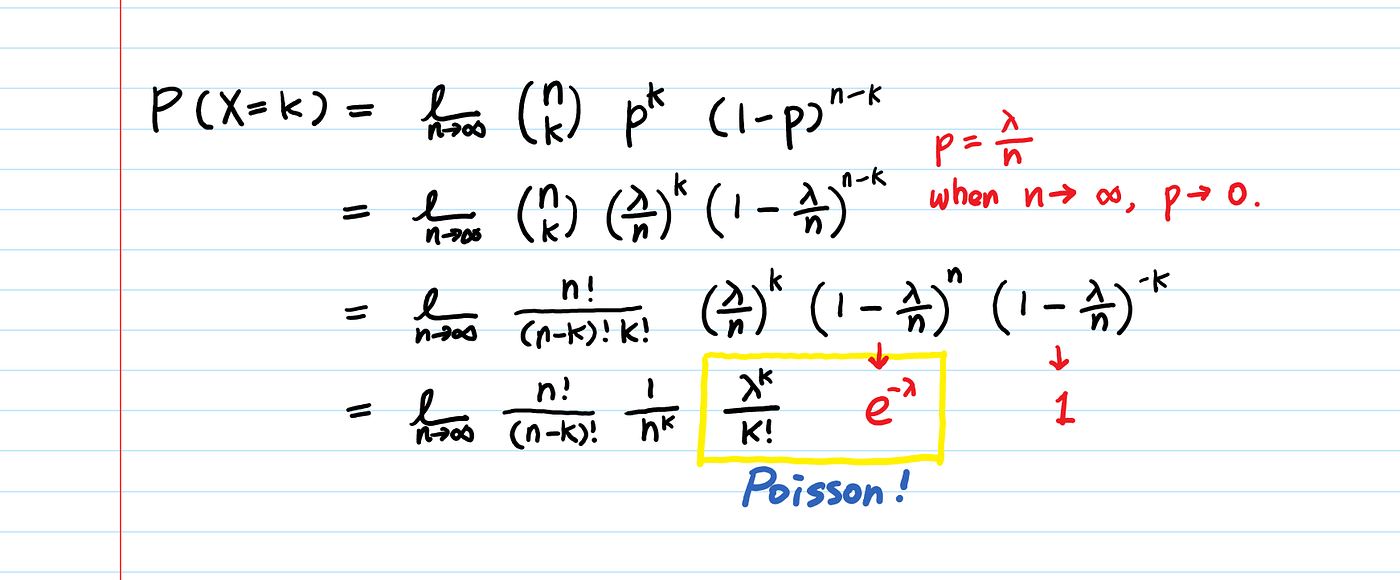
Now you know where each component λ^one thousand , k! and e^-λ come from!
Finally, nosotros only need to prove that the multiplication of the first 2 terms n!/((northward-thou)!*n^k) is 1 when n approaches infinity.
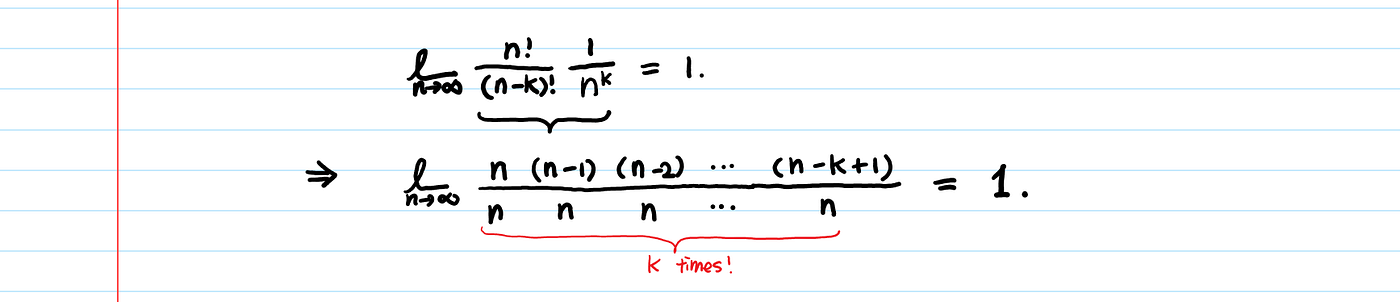
It is i.
We got the Poisson Formula!
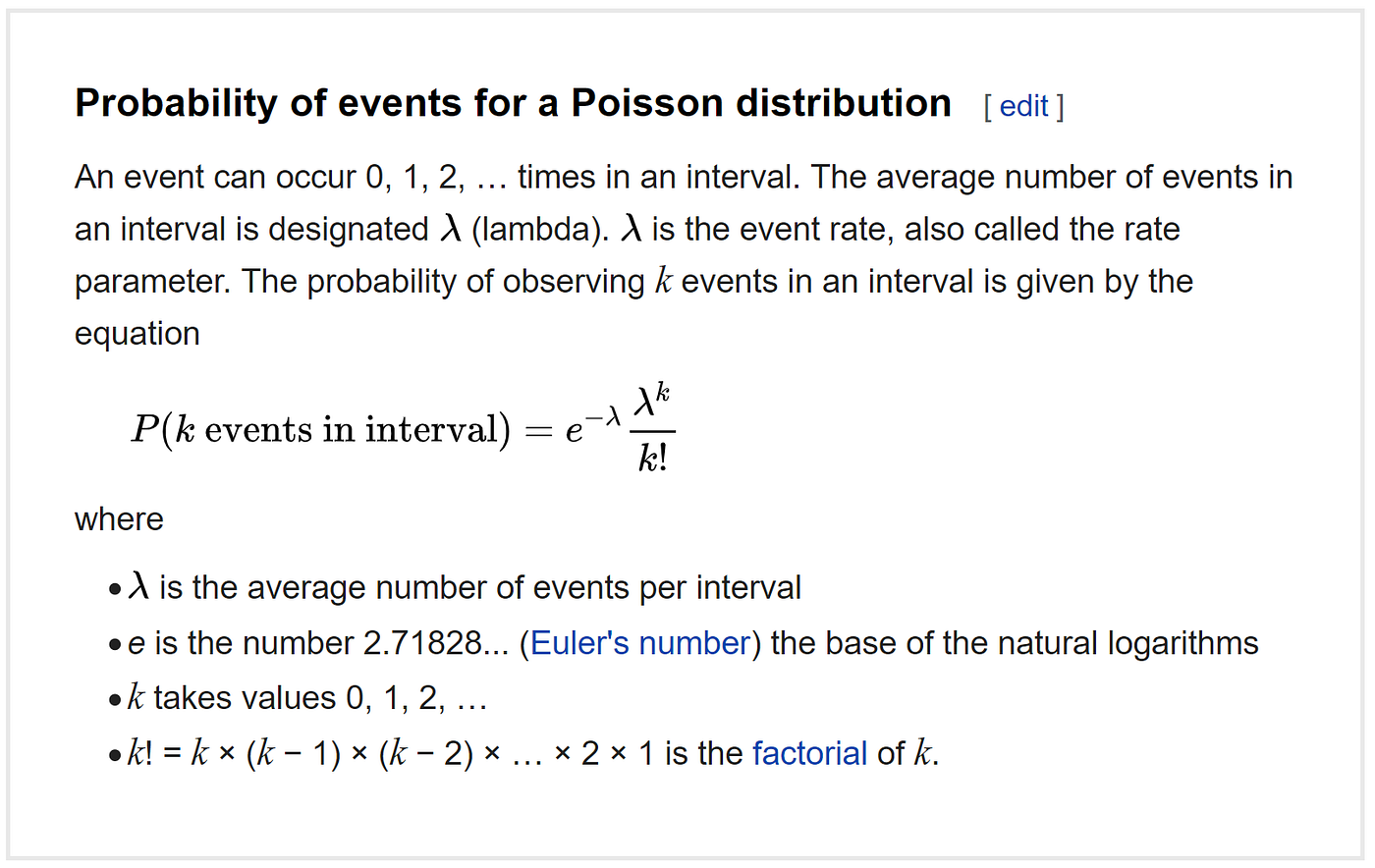
Now the Wikipedia explanation starts making sense.
Plug your own data into the formula and see if P(x) makes sense to you!
Beneath is mine.
                          < Comparing between Binomial & Poisson >                        ╔══════╦═══════════════════╦═══════════════════════╗
║              k              ║  Binomial P(X=g)  ║  Poisson P(Ten=k;λ=17)  ║
╠══════╬═══════════════════╬═══════════════════════╣
║  10  ║      0.02250      ║        0.02300        ║
║              17              ║              0.09701              ║                0.09628              ║
║  20  ║      0.06962      ║        0.07595        ║
║  30  ║      0.00121      ║        0.00340        ║
║  40  ║    < 0.000001     ║      < 0.000001       ║
╚══════╩═══════════════════╩═══════════════════════╝            * You tin can calculate both easily here:
Binomial:  https://stattrek.com/online-figurer/binomial.aspx
Poisson :  https://stattrek.com/online-calculator/poisson.aspx
A few things to note:
- Fifty-fifty though the Poisson distribution models rare events, the charge per unit λ can be whatever number. It doesn't always take to be small.
- The Poisson Distribution is disproportionate — information technology is always skewed toward the right. Because it is inhibited by the zero occurrence bulwark (at that place is no such thing every bit "minus one" handclapping) on the left and it is unlimited on the other side.
- Every bit λ becomes bigger, the graph looks more like a normal distribution.

4. The Poisson Model Assumptions
a. The boilerplate rate of events per unit fourth dimension is constant.
This means the number of people who visit your blog per 60 minutes might not follow a Poisson Distribution, because the hourly rate is not abiding (higher charge per unit during the daytime, lower rate during the nighttime). Using monthly rate for consumer/biological information would be just an approximation equally well, since the seasonality effect is non-trivial in that domain.
b. Events are independent.
The arrivals of your weblog visitors might not always be independent. For example, sometimes a large number of visitors come in a group because someone popular mentioned your blog, or your blog got featured on Medium's showtime folio, etc. The number of earthquakes per yr in a land too might not follow a Poisson Distribution if one large convulsion increases the probability of aftershocks.
5. Relationship betwixt a Poisson and an Exponential distribution
If the number of events per unit time follows a Poisson distribution, then the amount of time between events follows the exponential distribution. The Poisson distribution is discrete and the exponential distribution is continuous, yet the 2 distributions are closely related.
Let's go deeper: Exponential Distribution Intuition
If you lot like my post, could yous please clap? It gives me motivation to write more. :)
Source: https://towardsdatascience.com/poisson-distribution-intuition-and-derivation-1059aeab90d
0 Response to "Probability That 13 Students Will Take Up Art Poisson Dist"
Postar um comentário